Restructuring Design from Agile to Product-Oriented
Edify Education

Overview
Role
Design Manager / Lead Product Designer
Timeline
2021
Responsibilities
Team Structure & Org Design • People Management • Process Design • Cross-functional Alignment
Plaftorms
Web & Mobile
The Opportunity
Edify Education is a bilingual education platform for schools across Brazil. I managed its product design team, with up to 7 direct reports, through a period when Edify split off to become a standalone company.
As part of that transition, I co-led a restructuring of how the design team worked: moving it from a feature-team agile model to a product-oriented one.
The problem
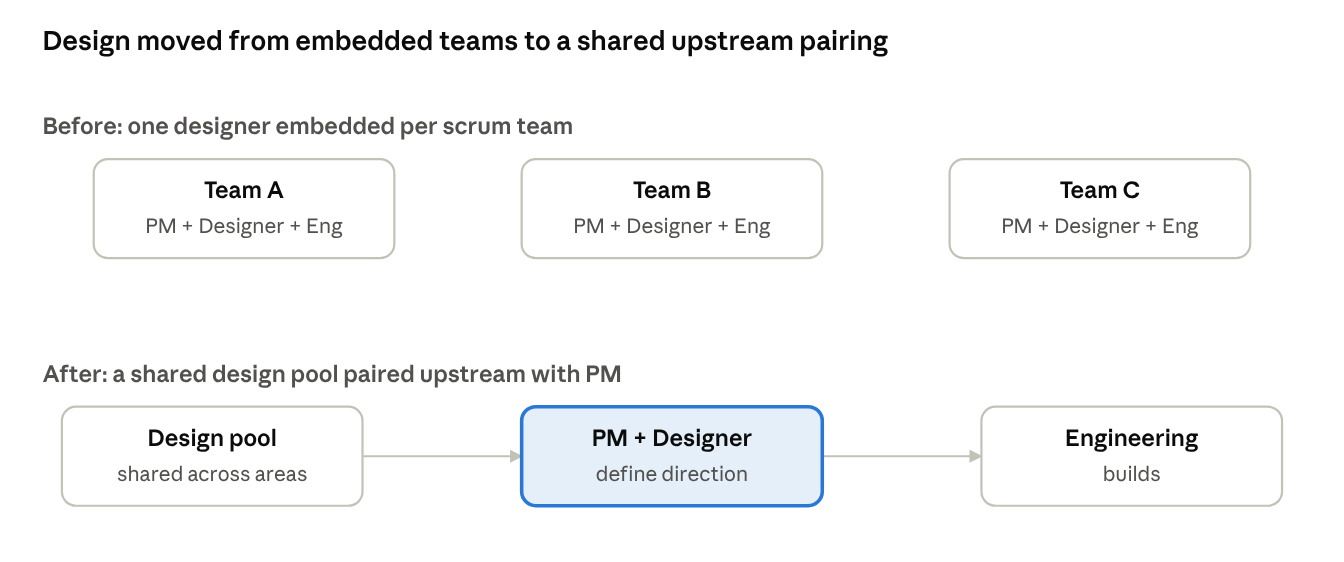
Our design team worked inside a standard feature-team agile setup: one designer embedded per scrum team, working sprint to sprint.
In practice this meant design came in too late to shape strategy, and designers had little ownership over outcomes beyond their own team's backlog.
It also meant we were spread too thin: with only a handful of designers for the amount of product work underway, a lean one-designer-per-team model gave us no flexibility to shift effort to where it was needed most.
My role
The restructuring was a joint initiative with other leads as Edify became a standalone company, and I led it for design specifically, while continuing to manage the team day to day.
The org split also reshaped the team itself: a few designers chose to stay with the former parent organization rather than move with us, so part of the work was reorganizing a smaller team around the new model at the same time.

We moved away from embedding a single designer inside each scrum team and set up a flexible design pool instead, allocated by need rather than fixed by team.
The bigger shift was upstream: product managers and designers began working closely together to define problems and direction before engineering was brought in, rather than engineers sitting alongside design and PM from day one.
Engineering moved to the end of that process, building against direction design and PM had already aligned on.
The New Structure